


 Français
Complete guide: automatic loading and unloading systems
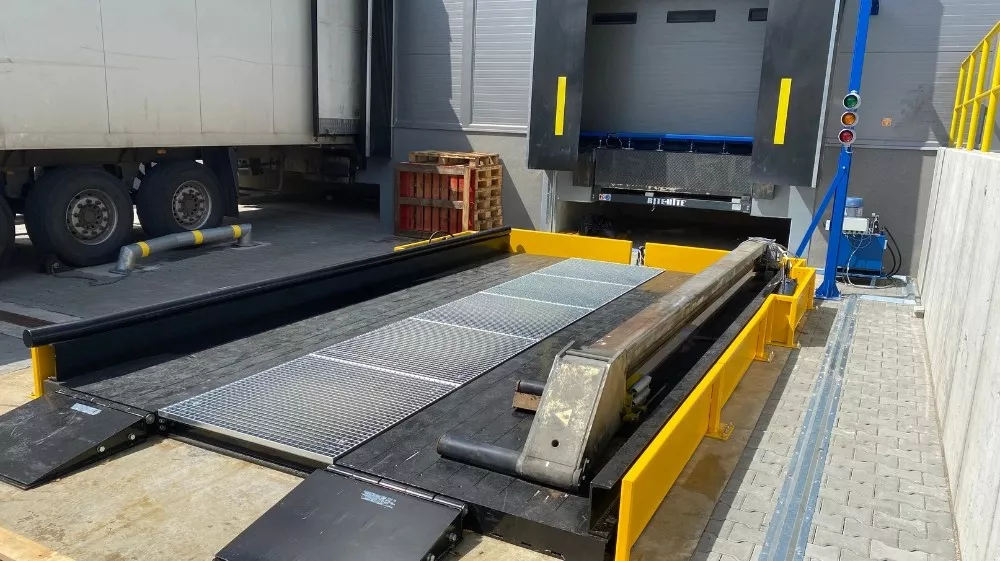
Automated truck loading and unloading systems are increasingly becoming a practical solution for making dock operations faster, smoother, and safer.
For manufacturers and logistics platforms, loading docks are a crucial link: they are the heart of flow management. Their number directly determines the goods handling capacity and the volume of trucks that can be loaded and unloaded. In practice, a traditional (or un)loading operation (using a forklift or ride-on truck) can take around 30 minutes per truck, depending on the type and weight of the products. With automation, this time can be reduced to less than 10 minutes.
In this article, Forankra invites you to discover how these automated loading and unloading systems work and the daily benefits they bring to logistics teams.
What is an automatic truck loading and unloading system?
An automatic truck loading and unloading system, also known by its English acronym ATLS (Automatic Truck Loading Systems), is an automated solution that ensures the transfer of pallets and other goods between the truck and the warehouse in a robotic manner, with human intervention limited to supervisory operations.
Located at the loading docks, these systems occupy a strategic area of the warehouse, a true entry and exit point for the flow of goods. Their organization requires careful planning: dock configuration, choice of installation type based on available space, and precise sizing of the number of docks. This number depends on several factors, such as the volume of goods, the frequency of deliveries, receiving time slots, and the time required for unloading and transfer operations.
The integration of automatic truck loading and unloading systems leads to a rethinking of this organization. The reason: their ability to significantly accelerate operations. Reducing truck processing time automatically translates into better use of existing loading docks, and therefore potentially less infrastructure. This development has a direct impact on the overall warehouse layout, freeing up space that can be reallocated to higher value-added activities. Repetitive tasks are also reduced and automated, allowing for better utilization and increased value of labor.
How does dock automation actually work?
Automated loading and unloading systems operate through a series of standardized steps, which may vary slightly depending on the technology and equipment installed.
First, the truck reverses into position at the dock, usually with the doors already open. Once correctly aligned, access to the dock is secured and the work area is stabilized.
The next phase involves establishing the connection between the vehicle and the dock infrastructure, specifically via the power supply and interface devices necessary for the smooth operation of the system.
The transfer of goods can then begin. During unloading, the pallets or goods are transported to the warehouse via a network of conveyors, in the case of a fully automated system. During loading, the flow is reversed until the truck is ready to depart.
The entire process takes place in just a few minutes, with an enhanced level of security and human intervention reduced to control and supervision tasks.
Key Technologies in an Automated Loading Dock
The composition of an automated truck loading and unloading system depends heavily on the type of installation and the specific needs of the warehouse. There is no standardized model; each supplier adapts its solutions to the type of goods, truck size, and dock configuration.
The main components found in these systems include:
• Chain conveyors: depending on the system, pallet transfer may be done solely by chains.
• Slat conveyors (solid belt): these optimize pallet handling time by automating manual loading and unloading operations for all types of goods.
Should you modify your truck fleet to switch to an automated loading and unloading system?
The answer, generally speaking, is yes in most cases, especially if the truck fleet is dedicated.
Full automation relies on a combined system: equipment integrated into the truck (such as chain or slat conveyors, for example) and devices installed at the loading dock, designed to interact in a coordinated manner. This represents a significant investment, which explains why automated loading and unloading systems are most often deployed on internal shuttle routes.
In configurations where the flow of goods is controlled between a production unit and distribution centers, the application is particularly relevant. Since the fleet is managed internally, the equipment is amortized more quickly.
The exceptions that prove the rule
Some technologies allow for automated loading without modifying the trucks:
• The SKATELOADER allows loading of standard vehicles (tarpaulin-covered trucks, vans), not equipped and not dedicated to this purpose.
• Articulated robotic arms that grasp pallets and place them in the vehicle.
• Automated transshipment shuttles that circulate between several loading docks.
The 6 Major Advantages of Automation for the Supply Chain
Automated loading and unloading systems applied to loading docks offer several levers for improvement that directly contribute to the company's overall performance.
One of the first observed effects is increased productivity. Transferring a full truckload of approximately 33 pallets can be completed in just a few minutes, increasing the number of flows processed in both receiving and shipping.
Optimizing available space is another significant advantage. Reducing truck processing time accelerates the "dock to stock" process, decreasing the need for temporary floor storage areas and freeing up warehouse space for other operational uses.
The preservation of goods is also enhanced. The absence of rough handling during transfer operations reduces the risk of product damage, which helps limit returns and reverse logistics.
From an organizational perspective, human resource management is simplified. Because the dock area is particularly busy, automation reduces the number of operators needed for these tasks and allows them to be reassigned to higher value-added activities.
Another major benefit is improved team safety. Loading and unloading operations are among the most prone to accidents. Automating these operations helps reduce these risks and makes the dock area less congested and safer.
All of these improvements have a direct impact on reducing operating costs, particularly through decreased labor requirements, reduced wear and tear on handling equipment, and overall improved safety.
In this context, automated loading and unloading systems offer a solution that promotes a rapid return on investment.
Discover our automated loading and unloading systems
Conclusion
Automated loading and unloading systems are now established as proven solutions, fully integrated into modern supply chain optimization strategies.
In an environment of rapidly evolving markets, sometimes strained human resources, and ever-increasing time constraints, dock automation represents a concrete opportunity for improved performance and operational efficiency.
A review of existing facilities reveals measurable gains and paves the way for more efficient, streamlined, and better-controlled logistics, where loading docks become true productivity accelerators.
FAQ on Automated Truck Loading and Unloading Systems
What is the average time saved per truck with automated loading and unloading systems?
The savings range from 20 to 25 minutes per full truckload. Specifically, unloading time is reduced from approximately 30 minutes with conventional methods (forklift) to 5 to 10 minutes with automated systems. This difference translates to 2 to 3 additional truck rotations per loading bay per day, or a reduction in the overall fleet size.
What is the average ROI of an automated loading/unloading system?
For a facility handling at least 20 trucks per day, the return on investment is between 15 and 24 months. Key variables include local labor costs, the current accident rate, and the volume of traffic. The more congested the loading bays, the faster the ROI.
Can an automated loading and unloading system be integrated into an existing warehouse?
Absolutely. Installations can be carried out on existing buildings as well as new ones. A preliminary analysis verifies the floor load capacity, ceiling height, and available power supply. Only very old installations may require structural reinforcements.
Does automation work with all types of goods?
Automation is compatible with many types of goods, but its effectiveness depends on the nature of the products. Palletized and properly stabilized flows are particularly well-suited to this type of solution. On the other hand, unstable, fragile, or oversized loads require a specific assessment to determine the feasibility of automation.