


 Français

Lashing


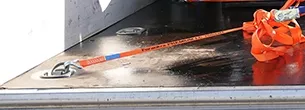


Load-securing and space-optimization equipment for original equipment in body shops or for resale.
Our products are designed for original equipment installation by body shops or for installation by your customers.
For safe use and securing, the load securing and space optimization equipment complies with European recommendations and load securing standards EN 12195-1, EN 12195-2, EN 12195-3, VDI2700, EN 1677-2, and European Directive 2003/10/EC of February 6, 2003.
Discover our wide range of accessories for commercial transport vehicles:
- Heavy-duty equipment: Standard or custom-made lashing straps compliant with European standards EN 12195-1 and EN 12195-2, anchor points, securing bars and securing beams on side panels or telescopic, integrated or recessed rails, double-floor systems, curtain bottom, chain securing, and anti-slip mats for tautliner vehicles and semi-trailers.
- Van: Standard or custom interior lashing straps, lashing rails for vans, lashing accessories for rails, Xtradeck double floor, equipment for refrigerated vans.
- Light Commercial Vehicle (LCV) Equipment: Straps for utility vehicles and light trucks, sliding bar tie-down rails for light commercial vehicles (LCVs), transport tie-down nets, tie-down rails, moving straps for light commercial vehicles (LCVs), recreational vehicles…
- Lashing hardware for securing cargo and optimizing space: Pins, ratchet tensioners, anchor points, strap rollers, curtain hooks, single-use lashing straps.
What types of securing equipment are available?
There are several types of securing equipment, including:
- Securing straps
- Anchoring points and systems
- Buckles and accessories
- Securing bars and beams
- Anti-slip mats
- Lashing nets
Additional accessories such as the Multistick multifunction pole for positioning straps and corner protectors. Also, strap reels or moving harnesses/moving straps…
How to Secure a Load Properly?
Load securing must be performed by a professional trained in this procedure. Before securing any load, it is essential to have a precise understanding of the load’s characteristics, as the choice of securing system depends in particular on its weight, the coefficient of friction, and the dynamic forces generated during transport. The EN 12195 standard provides the calculation method for determining the appropriate devices.
When using lashing straps, they must be positioned over the load and then secured to the designated anchor points, ensuring that the strap is not twisted so that it retains its full holding capacity.
The use of appropriate protective equipment, such as corner protectors or protective sleeves, is recommended to protect the edges of the cargo and extend the service life of the lashing equipment.
Tension is adjusted using a tensioner, either ratchet-type or reverse-type depending on the application. The free end of the strap is inserted into the tensioner shaft and adjusted before tightening. Once the appropriate tension is achieved, the tensioner must be properly locked to ensure reliable securing that complies with safety requirements.
How to Choose the Right Securing Solution?
To choose the most suitable securing solution, it is essential to consider certain factors in order to accurately assess your needs. First, you need to know the density of the cargo being transported, expressed in kilograms, cubic meters, or kg/m³—information that can be obtained from the manufacturer or via tables summarizing the densities of common materials. It is also important to identify the load’s center of gravity, which is easy to determine for standard geometric shapes but can be more complex for irregularly shaped objects. Although annual inspections of securing equipment are not mandatory, it is strongly recommended that you perform regular checks on your lifting and securing devices, as the company may be held liable in the event of a problem or accident.
What criteria should you use when choosing a lashing strap?
There are strict requirements for lashing straps used to secure loads. Here are the compliance factors to check.
Lashing straps must comply with standard NF EN 12195-2. Their label must include the manufacturer’s name, a traceability code, the year of manufacture, the applicable standard, the length, and the material used. It must also indicate the following three pieces of information:
- LC (Lashing Capacity): the maximum allowable tensile load, expressed in daN;
- SHF (Standard Hand Force): the manual force, expressed in daN, to be applied to the tensioner handle to tighten the strap;
- STF (Standard Tension Force): the residual force, expressed in daN, maintained in the system after releasing the handle, corresponding to the internal tension of the lashing device.


Questions & Answers
Existe-t-il plusieurs grades dans la gamme de chaînes d'arrimage?
Oui notre stock permet de fournir de la chaîne d'arrimage en grade 80, 100 et 120
are the straps customizable?
Does the color of the strap affect the resistance?
Do the straps need to be inspected?
What is the LC?
What is the STF ?
What is the SHF ?
Comment est composée une sangle d'arrimage ?
Selon les modèles, elle se compose soit de deux parties (une partie courte avec tendeur et crochet, et une partie longue avec crochet), soit d’une seule sangle équipée d’un dispositif de tension métallique pour un arrimage en boucle ou en ceinture. Chaque élément doit être identifié par un étiquetage conforme. Son utilisation doit respecter les instructions du fabricant et la norme EN 12195 afin de garantir la sécurité du transport et des opérateurs.
What is a corner piece used for ?
Comment installer une cornière ou un coin de protection sur une palette ?
Les cornières se positionnent sur les angles et points sensibles de la charge avant la mise en place du cerclage ou du système d’arrimage. Elles répartissent les efforts exercés par les sangles et contribuent à maintenir les marchandises en place.
L’utilisation de la perche multifonction Multistick avec son embout Corner-stick est l’outil indispensable pour effectuer cette opération sur un chargement tout en restant au sol, préservant ainsi la sécurité des opérateurs.
À quels secteurs s’adressent les cornières de protection ?
Les cornières et coins de protection sont utilisés dans le transport de tout type de marchandises conditionnées sur palettes, mais aussi des engins ou objets volumineux transportés et sécurisés avec des sangles d’arrimage.
Les cornières sont-elles compatibles avec tous les systèmes d’arrimage ?
Les cornières de protection sont compatibles avec la majorité des systèmes d’arrimage et de cerclage. Elles améliorent l’efficacité du maintien des charges en répartissant les points de pression exercés par les sangles et en limitant les risques de détérioration des emballages.
Existe-t-il des normes spécifiques pour les cornières de protection ?
Les cornières de protection ne sont pas soumises à une norme unique comparable à celles applicables aux équipements d’arrimage. Elles doivent néanmoins présenter un niveau de résistance et de qualité adapté aux contraintes du transport et de la manutention professionnels.
What is a anti-slip mat used for?
What is the load capacity of an anti-slip mat?
Is it easy to recut the rails?
Is the lashing rail recyclable?
Are there rails for commercial vehicles?
What is the purpose of a lashing bar?
Can the lashing bars be customised?
Quels sont les avantages des barres d’arrimage ?
Les barres de calage sont comme des cloisons mobiles, elles divisent les zones de chargement et sont adaptables. Positionnés à l’horizontal ou au vertical, elles permettent un maintien stable et précis des marchandises. L’installation des barres de blocage ne prend que quelques secondes.
Est-il possible d’utiliser une barre d’arrimage sans rail dans le véhicule ?
Oui, Forankra met à disposition des barres à patins comme l’ERGOBAR et la CARGO-STA. Ces dernières sont équipées de patins en caoutchouc et assurent le maintien des marchandises par friction directement sur le plancher, les parois ou le pavillon du véhicule. Chaque patin est remplaçable séparément.
Est-il possible de remplacer les accessoires de la barre d’arrimage ?
Forankra propose plusieurs accessoires de remplacement (embouts, patins...) afin de garantir la durabilité de vos équipements d’arrimage.