


 Français

Aluminium ramp

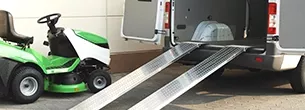
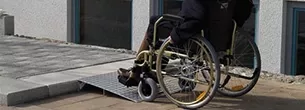

Make access and loading easier with our sturdy and secure ramps and plates.

Customised solutions

Reactivity & availability

40 years experience at your service

Dedicated sales team
Questions & Answers
How do I choose my ramps?
The choice of your ramps depends on a number of criteria: the type of equipment, the weight of the equipment and the height difference to be negotiated, which will determine the length, the suitable running surface and the gradient. EX: Equipment to be loaded: agricultural tractor, weight of equipment: 3.5T, difference in height to be negotiated: 900mm, the ramp will need to be 3m60 long, adapted to the tyres to cope with a gradient of 30%.
How do I calculate the slope?
Calculate the gradient: length (mm) = difference in height to be negotiated (mm) / gradient (%) x 100
How can I ensure that the ramp is stable?
For the ramp to be stable, it must be placed on flat, loose ground to avoid any risk of tipping over, and the ramps must be fixed to the vehicle floor.
What fixings are provided for ramps?
As standard, the ramps are supplied with a pierced support lip to be fixed to the vehicle floor using a stud supplied with the ramps. Other types of fixing are available depending on your requirements (available on the technical data sheet).
Can a ramp have side edges?
Depending on the type of ramp, side rails may be fitted as standard or as an option. Consult our technical data sheets
Is it possible to have a folding ramp?
Standard folding ramps are available for LCVs and vans, and optional ramps are available on models for equipment carriers, flatbeds and trailers.
Is it possible to have a fixed ramp?
Fixed ramps are available for all models
Can a ramp be used for a variety of purposes?
Yes, the ramp can be adapted to different heights, but the minimum and maximum height of the ramp must be respected
Do the ramps have a running surface suitable for loading?
Yes, the ramps have different running surfaces suitable for castors, pneumatic tyres, rubber or steel tracks and tyred wheels
Do you have a safety coefficient?
Yes, the elastic limit is 2.1: the ramp returns to position without deformation at 210% of the nominal load
Do ramps have a running surface suitable for loading?
Yes, the ramps have different running surfaces suitable for castors, pneumatic tyres, rubber or steel tracks and tyred wheels.
How do I choose my PRM ramp?
The choice of PRM ramp depends on several criteria: the place where the ramp will be installed (ERP, private home or in a vehicle) and the space available, which will determine the slope. Example for an ERP: Need for a ramp to negotiate steps with a total height of 400mm in a wheelchair, the ramp will have to be at least 6700mm long (400/6 x100).
Is there a PRM standard to be met?
Yes, according to the decree of 8 December 2014 and the decree of 20 April 2017, ramps must have a maximum slope of 6% for establishments open to the public. We adapt our PMR ramps to meet these standards
Can a PRM loading ramp be adapted to all configurations?
We have selected a very wide range of aluminium ramps to meet the needs of most the majority of configurations, whether for crossing thresholds, door rails, steps or even for going up and down stairs or for getting in and out of vehicles.