


 Français

Dock Equipment
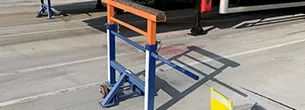

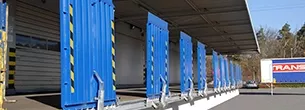
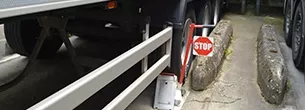

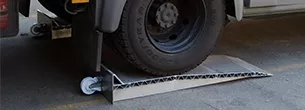
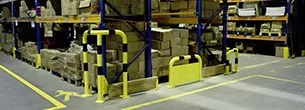

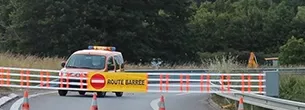
Forankra dock equipment is an essential asset for distributors and bodybuilders looking to optimize loading and unloading operations.
Our comprehensive range includes: trailer jacks and safety trestles, dock bumpers, loading ramps and plates, wheel chocks, wheel guides, lifting blocks and risers, warehouse and parking lot equipment, hand trucks and pallet jacks, and textile barriers.
These solutions are designed to enhance safety, protect infrastructure and vehicles, and streamline the flow of goods between trucks and loading docks, while also facilitating the work of transport and bodywork professionals.

Customised solutions

Reactivity & availability

40 years experience at your service

Dedicated sales team
Questions & Answers
When should you install a trailer horse or a trailer jack ?
In the absence of a tractor, a trailer horse must be installed to guarantee the safety of operators during loading and unloading by preventing the semi-trailer from tipping over.
What is the difference between a trailer horse and a trailer jack?
The trailer horse is positioned passively, with a distance between the trailer horse and the vehicle, while the trailer jack is positioned actively, in contact with the semi-trailer.
What is the difference between a steel bumper and a rubber bumper?
The rubber bumper cushions the impact of the semi on the dock and is suitable for less intensive use. The steel bumper provides similar cushioning, but the 10 mm steel impact plate ensures more durable use and is suitable for intensive use.
When should I use a dock leveller?
The extension, which is always positioned on the driver's side, prevents vehicles from tipping over onto the platform, and guarantees a wider range of use for the bumpers.
What is a refuge area?
In accordance with CRAM recommendations, the refuge area prevents operators from being crushed in the event of a fall or intervention in the vehicle parking area between the platform and the semi, by guaranteeing a survival space. The refuge area complies with standard EN 1398
How do I secure a quay?
To secure a loading bay, we recommend all the devices in the dock equipment accessories range (e.g. wheel chock, wheel guide, loading bridge with refuge area, trestles and support legs, etc.).
I don't have a U-iron on my platform nose. How do I install the dock?
You need to fit a U-iron or metal angle (dimensions to be specified on the technical data sheet, depending on the model) to the dock nose so that you can weld the dock.
Is there a solution for handling a loading dock more easily?
Yes, depending on the model, there are articulated docks compensated by gas struts or springs to limit the effort involved in handling.
Do you have steel dock?
Yes, we have a range of articulated steel cranes (type FBSS and FBSV).
Do the docks respect the refuge area?
Yes, all our docks comply with the safe area standard (NF EN 349)
Is there a slope required for loading docks?
Yes, the docks are designed so that the slope in the working position does not exceed 12.5% (standard EN1398)
Can a dock be made to measure?
Yes, we can offer you a solution with non-standard dimensions on request and after a feasibility study.
Why use a wheel chock?
The wheel chock is a device that limits vehicle departure and informs the driver of its presence.
What is the difference between a manual wheel chock and an electric wheel chock?
The manual wheel chock is a device that prevents the vehicle from leaving and informs the driver. The electric wheel chocks can be connected to all the dock devices, door, traffic light and buzzer, to ensure that all those working on the dock are kept informed.
Why install a wheel guide on the dock?
The wheel guide helps the vehicle driver to centre the vehicle when docking.
What is the purpose of car park and warehouse protection?
They are used to position vehicles and protect the building, particularly on new or recent buildings.
Why choose a trolley and a forklift?
We have a wide range of products that can be adapted to different needs
What is the purpose of a textile barrier?
The textile barrier is used to block access, inform the public, secure an area (market, school exit, event, unloading area, etc.).
What is the difference between a manual and semi-automatic barrier?
The manual barrier must be picked up and put back into the box by hand by the operator. The semi-automatic barrier has a roll-up mechanism for easy storage.
Is it possible to customise a textile barrier?
It is possible to customise the length, marking, type of fixing, colour of the box, etc.
What are the advantages of a textile barrier?
The textile barrier is always on station, can be deployed in less than a minute by a single operator and requires no special skills. The retro-reflective marking ensures visibility day and night.
Does the barrier require any special maintenance?
A quick check of general condition and possible rigging/lubrication is recommended once a year.
What installation work is required?
All you have to do is fix the posts, and there's no need for heavy earthworks or a power supply.