


 Français
Safety Stand : A Guide to Ensuring Safe Dock Operations
Key Points
- The safety stand is a docking device that stabilizes an unhitched trailer during loading and unloading.
- It reduces the risk of tipping caused by load movements and vehicle imbalance.
- It protects operators and equipment in logistics areas.
- Key selection criteria: height range and compatibility with trailers.
- The safety stand should be integrated into a comprehensive safety program (training + maintenance + prevention).
When a trailer is unhitched for parking, loading, or unloading, it typically rests on its original parking stands. While these provide basic stability, they are not always sufficient to prevent the risk of tipping, particularly during loading and unloading operations where movements caused by loaded material-handling equipment passing by can alter the trailer’s balance
To enhance operator safety and ensure safe operations at the loading dock, the use of a safety jack is strongly recommended in addition to the parking stands. These jacks remain in constant contact with the semi-trailer and prevent it from tipping over.
What is the role of a trailer safety jack? Why is it essential when unhitching? And what are the best practices for using it effectively? Forankra has all the answers!
What is a trailer safety stand?
Definition and Function
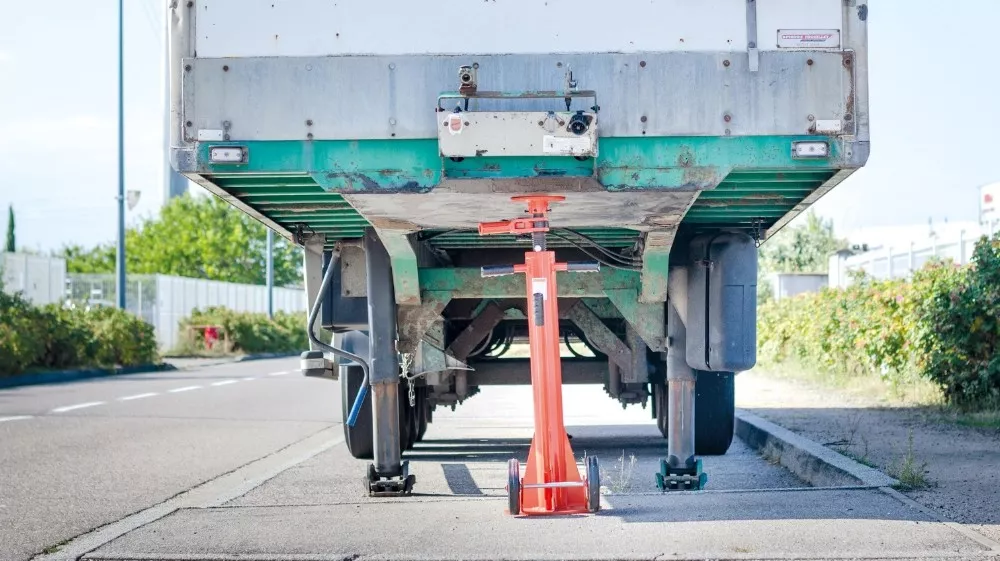
A safety stand is a loading dock device that maintains the stability of an unhitched trailer or semi-trailer. This device secures trailers at loading docks.
Its role is to create a stable support point under the trailer’s chassis using a support plate that distributes the load over a wide contact area.
This device is an essential piece of equipment on a loading dock, just like wheel chocks and dock bumpers.
Applications
The safety stand is used on loading and unloading docks, temporary parking areas, and logistics parking lots. It is deployed as soon as a trailer is unhitched.
The transportation, logistics, and industrial sectors use this type of equipment on a daily basis to prevent accidents.
What Are the Risks of Tipping?
Understanding the Risk of Tipping
The risk of tipping occurs when the trailer’s center of gravity shifts. During loading or unloading, the weight of the cargo is concentrated at the front or rear of the vehicle. Without a stabilizing device, the trailer may tip forward.
Trailer tipping is one of the most serious types of accidents at logistics sites. The consequences include injuries to people on site, property damage to dock equipment, and operational disruptions. The stabilizer leg maintains stability even when heavy loads are being moved.
Operator Safety
The stabilizer protects forklift operators and material handlers from the risk of tipping. It also protects load-carrying trucks, forklifts, loading docks, and trailers from damage.
How does a safety jack work?
The safety jack is based on a height-adjustable lifting system. This device is positioned under the trailer chassis and provides a stable support that distributes the static load across the ground. An operating lever makes it easy to move and position the device.
The adjustment mechanism allows the height to be adapted to different types of chassis. Once in position, the jack locks into place to maintain stability throughout the entire operation.
Technical Specifications
The safety stands consist of several technical components:
- A sturdy steel frame
- A wide support base
- Rubber wheels for mobility
- An ergonomic operating lever and an adjustable lifting system.
How do you install a safety stand?
Installing a safety stand involves several steps:
Step 1
- The operator positions the stand under the front of the unhitched trailer using the height-adjustment ratchet. The rubber wheels make it easy to move the device.
Step 2
- The operator then adjusts the height according to the type of vehicle and the level of the loading dock. The adjustment is made using a manual lifting system or a jack, depending on the model.
Step 3
- After reaching the desired height, the operator checks the stability of the assembly. The support must rest firmly on the ground and hold the chassis without any play. The support point must be stable, and the support surface must be correctly positioned.
Step 4
- Once loading or unloading is complete, the operator removes the device to release the trailer.
Adjustable Height Range
The adjustable height range determines compatibility with different types of chassis. Trailers and semi-trailers have varying heights depending on their design and load. For example, a model adjustable between 1,100 and 1,400 mm covers most standard configurations.
Dealers should verify compatibility with their fleet before purchasing. An insufficient adjustment range limits the device’s usability. The adjustment system must allow for easy height adjustment.
What types of support stands are available?
Forankra offers three types of support stands designed for different uses:
- The jack-style support stand (Secu-truck) is suitable for occasional use and at sites where the device must be moved frequently between multiple loading docks. Its design promotes mobility and ease of maneuvering thanks to its rubber wheels and ergonomic control lever.
- The hybrid jack (Secu-truck +) offers a balance between mobility and stability. It meets the needs of sites with regular use and varied operations. Its versatility makes it a suitable choice for distributors serving multiple types of customers. This model features a reinforced support surface.
- The wide support leg (Secu-truck ++) provides enhanced stability for heavy loads and intensive use. Its design prioritizes durability and reliability on loading docks used for repeated operations. The wide support plate ensures optimal distribution of the static load.
Note: The choice depends on the frequency of use, the type of operations, and site-specific constraints. Each model has specific technical characteristics detailed on the product sheet.
Incorporating the Safety Stand into Your Risk Prevention Plan
Incorporating a safety stand begins with a thorough risk assessment. Managers must identify high-risk areas based on the frequency of unhitching, trailer types, and material handling flows.
Analyzing past incidents helps prioritize areas for action and determine equipment requirements. The risk prevention plan must include safety measures tailored to each work area.
Training Operators
Operator training is essential to ensure the effectiveness of the stabilizing system. Teams must understand the risks of tipping, master the correct installation of the stabilizer, and follow verification procedures before each operation.
Dock supervisors and forklift operators must incorporate the use of the support leg into their daily routines. Training covers installation steps, checkpoints, and safety guidelines.
This awareness-building strengthens the safety culture and reduces risky behavior. Operators learn to verify the position of the device, the stability of the support point, and the proper functioning of the locking system.
Maintenance and Inspection
Regular maintenance ensures the reliability of the leveling device. Inspections focus on the overall condition of the support leg, the operation of the lifting mechanisms, and the effectiveness of the locking system.
Any defective equipment must be replaced immediately. Maintaining a record of inspections allows you to track the condition of the equipment fleet and plan for replacements in advance.
Conclusion
The safety jack is much more than just a dock accessory. It is an essential piece of equipment for ensuring the safety of loading and unloading operations for unhitched trailers. By ensuring vehicle stability, it helps reduce the risk of accidents, protect operators, and ensure the continuity of logistics operations.
To select the right stabilizer, it is essential to evaluate its load capacity, height adjustment range, and frequency of use to precisely meet the site’s requirements. As part of a comprehensive safety policy that combines safety procedures, team training, and regular equipment maintenance, it helps create a safer, more reliable, and more efficient work environment[VG5.1]. It is also an easy system to set up, thanks to its wheels and quick positioning, even on uneven ground.