


 Français
The art of load securing in a utility vehicle
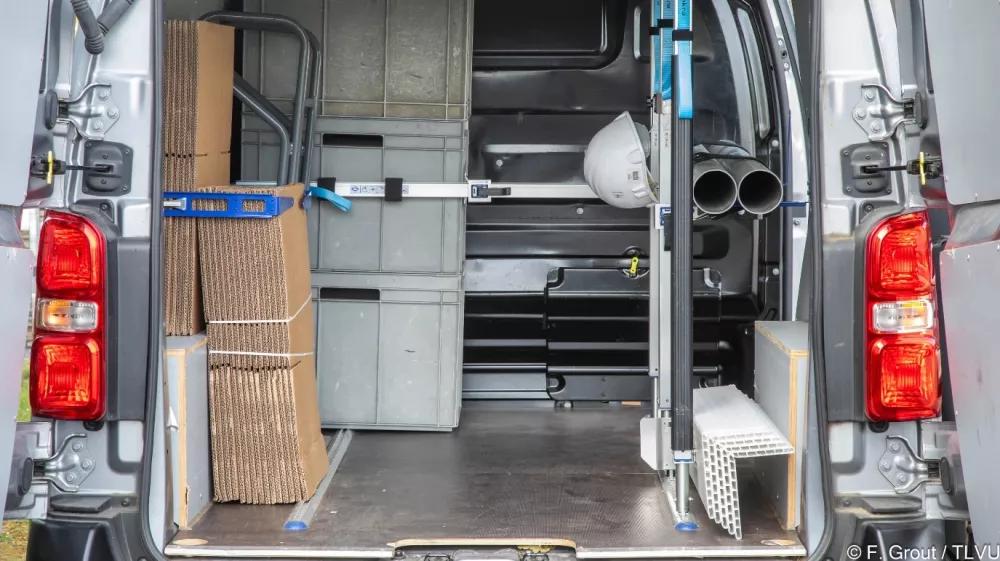
Essential Cargo Securing in Commercial Vehicles
- Inadequate cargo securing can cause movement during braking, cornering, or acceleration, leading to accidents and material damage.
- Effective cargo securing relies on four key elements: space organization, weight distribution, and the selection of appropriate solutions.
- Compliance with EN 1295 standards and the highway code is mandatory for all goods transport.
- Cargo securing solutions are adapted to the nature of the load to ensure its effective restraint during transport (tie-down bars, straps, cargo nets, etc.).
Why is load securing important for all commercial vehicle transport?
A load shifting on the road poses a direct risk. With every braking, turn, or acceleration, goods move. The cargo is damaged, the vehicle loses stability, and accidents become likely. Therefore, load securing in commercial vehicles is not simply a matter of logistical organization; it is a matter of road safety and legal compliance. Every journey requires precise anticipation of the forces at play.
How do loads react to the movements of a commercial vehicle?
The forces exerted on a load depend directly on the type of movement the vehicle is subjected to. Anticipating these forces is essential for choosing the right load securing solution.
| Type of movement | Load direction | Impact to anticipate |
| Acceleration | Towards the back | The goods slide towards the back of the van |
| Braking | Forward | Forward projection, risk of damage |
| Turn | Lateral | Tilting or sliding outwards from the curve |
| Degraded road | Unstable | Repeated shaking |
The tension exerted on a lashing strap depends on the weight of the load and traffic conditions. Failing to anticipate these movements increases the risk of damage and compromises the protection of the goods.
The four pillars of effective security
1. Cargo Area Organization
The cargo area of a van or light commercial vehicle must be organized before loading. A well-chosen cargo kit allows you to organize this space and optimize the vehicle's interior layout. This organization directly improves the overall stability of the load.
2. Weight Distribution
The positioning of the heaviest loads directly impacts transport safety. Goods must be distributed in such a way as to maintain the vehicle's balance and minimize movement during road journeys.
3. Selecting Appropriate Securing Solutions
Each transport configuration requires a specific combination of equipment such as straps, tie-down rails, locking bars, pins, and anchors.
4. Correct Equipment Use
Even with the best equipment, improper setup compromises the entire load security system. Training in the correct use of equipment is essential for field teams.
Regulations, standards and compliance for LCVs
All goods transport by commercial vehicle must comply with:
- The French Highway Code
- The EN 1295 standard for load securing straps
These requirements are mandatory. Compliance with load securing standards ensures greater load security and reduces incidents on the road. In the event of an accident or roadside check, non-compliance may result in criminal penalties and civil liability.
Available tie-down solutions: a comparison
| Solution | Main Use | Adapted to | |
| Tie-down bar | Load retention and separation | Vans, H1, H2, H3 and LCVs | |
| Lashing rails (universal or aeronautical) | Multiplication of anchor points | Modular layout | |
| Tie-down rings / anchor point | Securing the tie-down straps | All commercial vehicles | |
| Tie-down strap (ratchet strap, claw cam, etc.) | Fastening of goods | Light to heavy loads |
These solutions are adapted to the needs of utility kits and van conversions, particularly for fleets of Renault, Volkswagen, Mercedes, Fiat and Ford, among others.
The SMARTBAR range: locking bars for every commercial vehicle
Designed to secure goods in commercial vehicles, the SMARTBAR range has been developed to adapt to different vehicle sizes. It is available in several models to meet the needs of transport professionals.
SMARTBAR bars stand out for their locking capacity and ease of installation. Their adjustment mechanism relies on a spring compression system, facilitated by an ergonomic handle positioned at arm's height. Its design allows for one-step installation while helping to reduce the risk of musculoskeletal disorders (MSDs). Made of aluminum, they are also fully recyclable.
• SMARTBAR
Suitable for H1 and H2 type commercial vehicles, the SMARTBAR offers a clamping capacity of 350 daN, sufficient to effectively secure loads transported in light commercial vehicles (LCVs). Adjustable from 1.65 m to 1.95 m, it easily adapts to the vehicle model.
• SMARTBAR Vinyl
A recent version of the SMARTBAR, this clamping bar was developed to protect sensitive products during transport and storage. Its black vinyl coating limits scratches on goods and thus reduces the risk of damage, particularly to fragile surfaces such as glass.
• SMARTBAR HD
With a clamping capacity of 400 daN, the SMARTBAR HD provides reinforced support for goods and limits their movement during braking or evasive maneuvers. It is adjustable from 2.20 m to 2.50 m to fit H3 type vans and LCVs.
The SMARTCONNECT range: a modular load securing solution
Designed for SMARTBAR tie-down bars, SMARTCONNECT allows you to attach various accessories to create a customized load securing solution in a light commercial vehicle or small truck.
It features an ergonomic handle on one side, while the other three sides have aerodynamic slots for installing tie-down and securing elements.
With SMARTCONNECT, Forankra is developing a range of accessories designed to meet operational needs in the field. The entire system is compatible with SMARTBAR bars as well as with the aerodynamic rails already installed in many light commercial vehicles and vans.
SMARTCONNECT Accessories
- SMARTBLOCK: A dunnage board designed to secure and stabilize packages and boxes during transport. Compatible with SMARTCONNECT and aircraft rails.
- SMARTRACK: A shelf designed for transporting long items such as pipes, rods, or profiles. Adjustable orientation (mountable on the long or short side as needed).Compatible with SMARTCONNECT and aircraft rails.
- SMARTHOOK: An adjustable hook offering two positions (vertical or horizontal) for hanging various tools or equipment. Dimensions available upon request. Compatible with SMARTCONNECT and aircraft rails.
Lashing rails for structuring the cargo space
Lashing rails structure the cargo space and enhance the modularity of cargo securing in commercial vehicles.
Available rail types
- Profile 500 – Semi-circular AERO rail
- Profile 500 – Semi-circular AERO rail with integrated LED strips
- Universal lashing rail
- Single AERO pin with ring
- Single anti-vibration pin
Installation
The rails are attached to the walls of the commercial vehicle. Installation is quick and easy, simplifying the outfitting of the van or light commercial vehicle.
Use
The rails structure the cargo space and allow for:
- The addition of flexible anchor points
- The attachment of lashing straps
- The rapid adaptation of the load according to the route
This modularity is invaluable for field teams carrying out various transport operations.
The tie-down straps, the key element of the system
Lashing straps play a central role in securing loads.
- Automatic lashing straps
- Ratchet lashing straps
- Cam lashing straps
The choice depends on the load weight, tension force, frequency of use, and compatibility with anchor points.
• SNAPSTRAP Cam Buckle
The 25 mm strap features a redesigned cam buckle with an easy-opening system that improves ergonomics and significantly reduces lashing time. With a load capacity of 220 daN for the blue SnapStrap or 300 daN for the red, it perfectly meets the needs of tradespeople, delivery drivers, and individuals, making load securing accessible to everyone.
• ROLLO Strap
The ROLLO strap is an automatic solution with an integrated retractor. Available in 25 mm or 50 mm widths, it offers a load capacity of 250 daN (for the 25 mm version) and 500 daN (for the 50 mm version). Particularly easy to use, it is compatible with several types of lashing rails. Its automatic one-click winding system saves time while ensuring secure fastening of goods.
• 25 mm straps with cam buckle
These versatile straps are ideal for securing light to medium loads requiring precise tightening. Their load capacity varies depending on the model, adapting to the specific needs of transport professionals. The buckle mechanism allows for quick and reliable adjustment, offering a practical and efficient solution for securing goods.
• Straps with Comfort-Line ratchet tensioner
These straps are equipped with an ergonomic blue "Comfort Line" handle, specially designed to facilitate tensioning while providing comfortable handling.
• Straps with aviation-grade pins
Designed for light commercial vehicles equipped with aviation-grade rails, these straps ensure modular and reliable load securing. Their direct integration into the rails guarantees a stable and quick attachment, easily adapting to different vehicle configurations for the secure transport of goods.
Lashing rings and anchor points
Lashing rings and anchor points are the connections between the fastening system and the straps. They secure the straps in the cargo space and ensure the lashing complies with EN 1295.
Additional accessories for van conversions
To complete a high-performance load securing system:
- Load securing nets
- Anti-slip mats
- Curtain bottoms
- Load securing beams
- Corner protectors
FAQ – Cargo Securing in Commercial Vehicles
What types of equipment are available for commercial vehicles?
Several cargo securing solutions are available, such as tie-down bars, tie-down rings, tie-down rails, and tie-down straps. Each option is suited to a different use depending on the type of load.
How do I choose tie-down straps?
The choice depends on the weight being transported, the required tension level, and compatibility with the existing tie-down points in the vehicle.
How do I install tie-down profiles in a commercial vehicle?
These elements attach directly to the interior walls of the vehicle. Installation is quick and adaptable to the available space.
What are the risks of improperly securing loads?
An improperly secured load can shift during maneuvers. This can also cause a loss of vehicle stability, damage the transported equipment, and increase the risk of an accident.
What factors influence the cost of cargo securing equipment for commercial vehicles?
The cost varies depending on the material used, the type of solution chosen, and the technical performance of the equipment.