


 Français
Overview of Load Securing Techniques
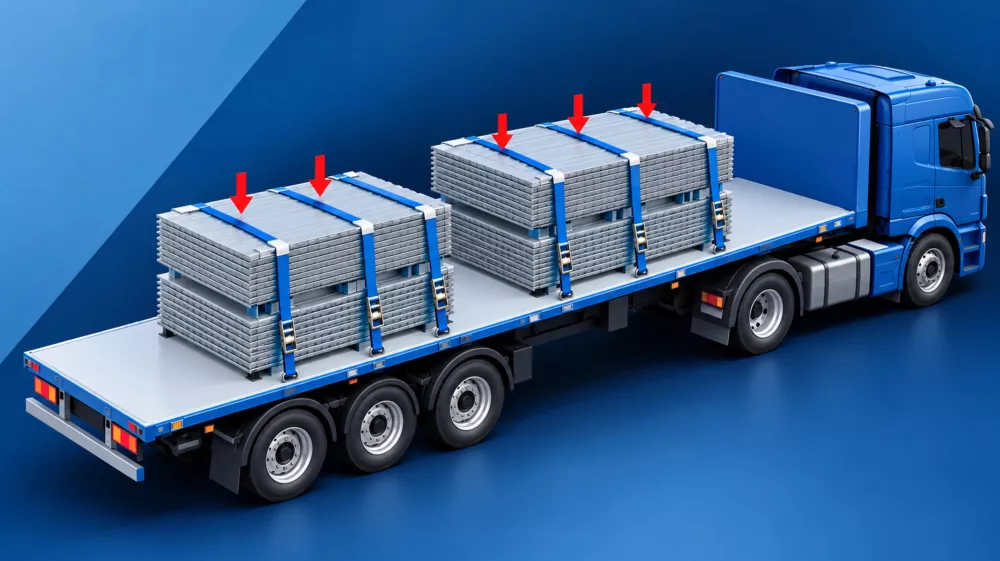
Securing a load cannot be done on the fly. Before any transport operation, it is essential to identify the securing method best suited to the characteristics of the load and the vehicle: nature, mass, dimensions, stability, and center of gravity of the load; coefficient of friction; strength of the securing points; and characteristics of the vehicle body. It is this preliminary analysis that determines the best technical approach to take.
Each method also follows its own logic, with an associated parameter, for the sole purpose of preventing the cargo from sliding or tipping over while in transit. Forankra offers its expertise to guide you toward the most appropriate equipment for the chosen method.
Friction-Based Securing
The principle involves tensioning devices (straps or chains) positioned above the cargo to increase the friction generated at the point of contact with the floor until sufficient resistance is achieved to counteract the inertial forces at play.
This technique has the advantage of simultaneously addressing the two major risks—namely, sliding and tipping—provided the straps are properly sized.
The tension of these devices must be checked regularly during transport, particularly after the first few kilometers and whenever transport conditions may have caused the load to loosen or shift.
Protective angle brackets can also be incorporated to protect the straps and/or the load when passing over sharp edges.
Direct Angled Securing
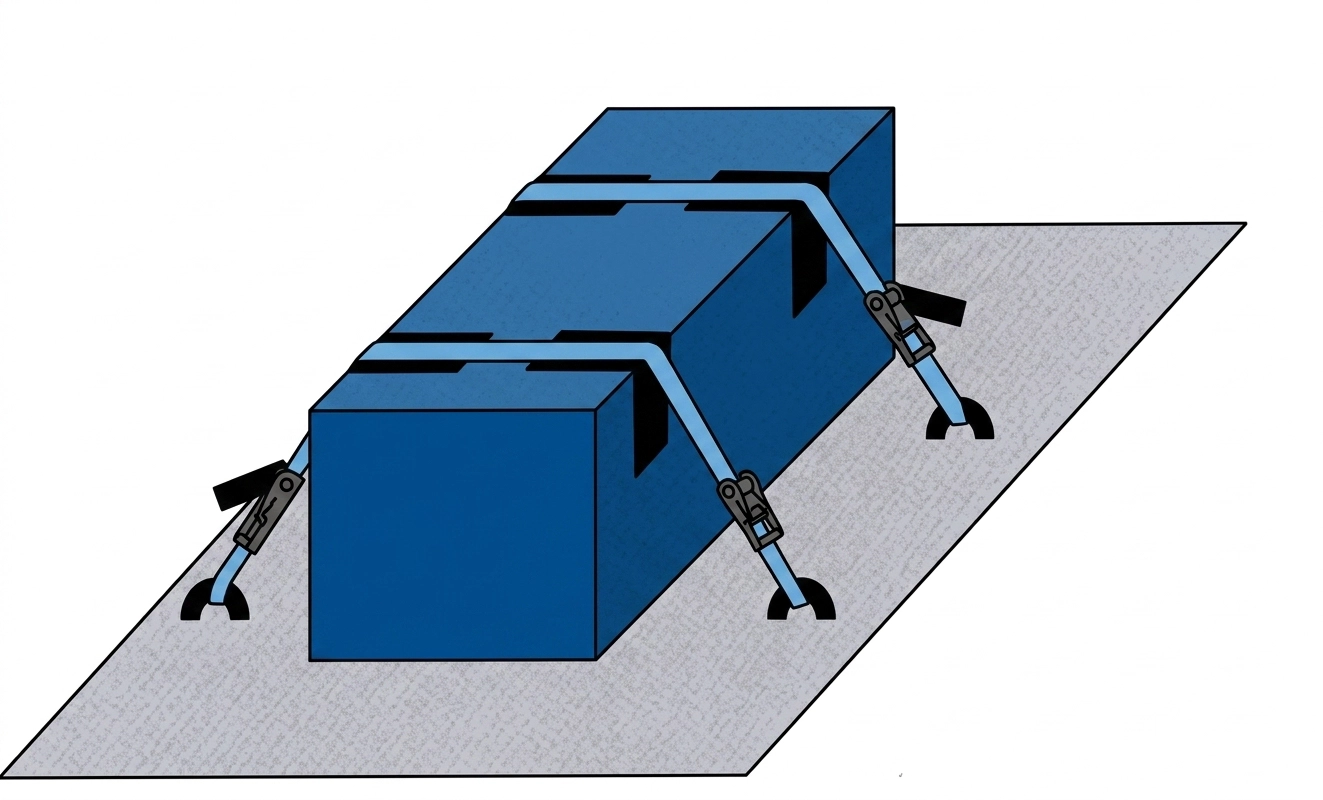
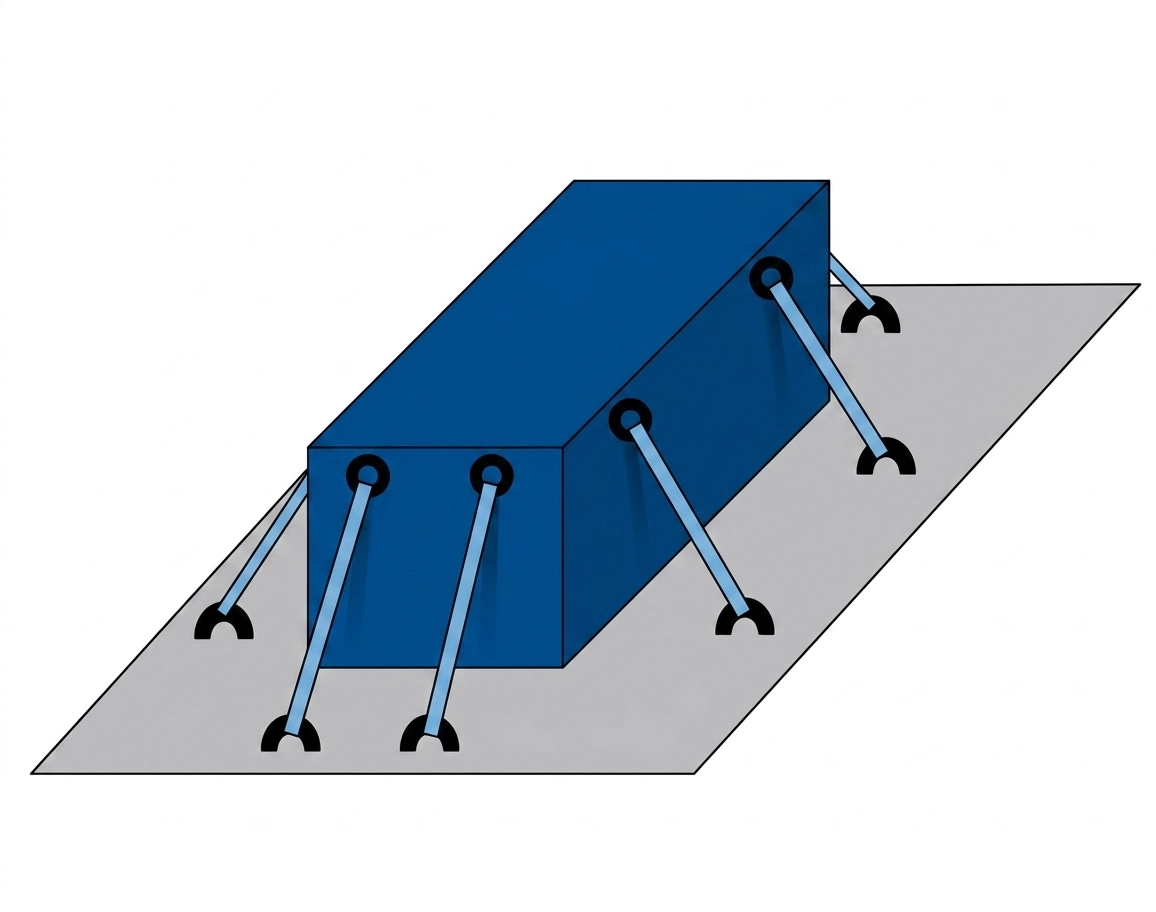
This method is primarily intended for loads that are difficult to stabilize, as well as heavy-duty vehicles. It involves equipment designed to withstand the stresses caused by the weight and movement of the cargo, thereby keeping it firmly secured on the vehicle’s cargo bed.
The effectiveness of this method depends in particular on the lashing capacity (LC) of the equipment, the strength of the lashing points, and the geometry and angles formed by the devices.
The lashing equipment is tensioned so as to form an angle close to 90° with the outer edge of the loading deck.
Block-and-brace securing
This method uses the vehicle’s walls or front partition to secure the load and prevent any movement during transport. Struts, chocks, uprights, or cushioning pads—resting directly or indirectly on fixed components—also contribute to this securing system.
Before opting for this solution, it is necessary to ensure that the vehicle’s structure is capable of withstanding the forces generated by the load, and that its strength meets the EN 12642 L or EN 12642 XL standards, as applicable.
For the securing system to be effective, any gaps must be minimized. Where gaps remain, they must be filled using appropriate shims to prevent any significant movement of the load.
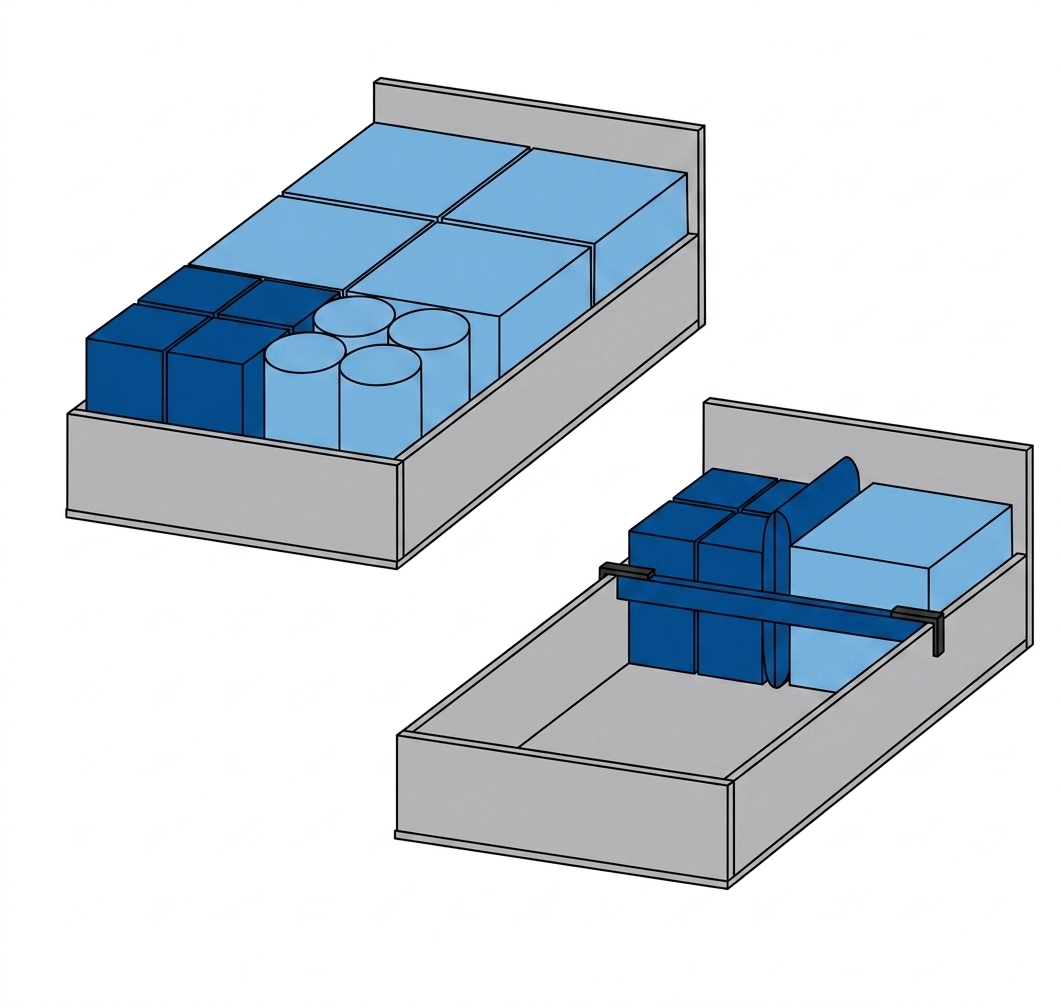
Securing the cargo is effective only if the following conditions are met:
- No gaps between the cargo items
- The securing forces are sufficiently strong to absorb the inertial forces during transport
Strapping
This technique is used to secure multiple packages together or to fasten them to a pallet, creating a more compact unit that is easier to handle and transport. The key parameter to monitor here is the clamping force (CF), which directly determines how securely the packages are held in place.
Diagonal Securing
This method requires the installation of a securing device at each of the four corners of the load. Each securing device must be tensioned diagonally across the loading deck to distribute the forces in multiple directions simultaneously.
Combined, Diagonal, and Angled Lashing
Combining angled lashing with diagonal lashing is still a relatively uncommon practice. Nevertheless, it is a useful alternative for effectively securing heavy cargo, particularly in the direction the vehicle is traveling.
The lashing equipment must be tensioned diagonally across the loading deck.
Anti-rebound lashing, or loop lashing
This method involves arranging the lashing equipment in a loop at the front, rear, or sides of the load, then securing it to the designated anchor points on the vehicle. Originating in maritime transport, this technique is traditionally referred to there as “loop lashing” or “handle lashing.”
It can serve as a substitute for the front or rear wall of the vehicle when the cargo has not been secured using dedicated longitudinal lashing. In practice, the lashing equipment must be held in place using appropriate accessories and then secured to the vehicle’s lashing points; no anchor points on the cargo itself are required.
Side-Loop Lashing
Another variation of direct lashing, this technique involves positioning the lashing straps in a loop around the sides of the cargo before securing them to the vehicle’s tie-down points. It compensates for the absence of side walls or situations where the cargo’s dimensions prevent any contact with them.
However, it is important to keep in mind that a side loop secures the load only in the right and left directions. This method is also particularly well-suited for securing cylindrical loads.