


 Français
Everything You Need to Know About Ratchet Straps
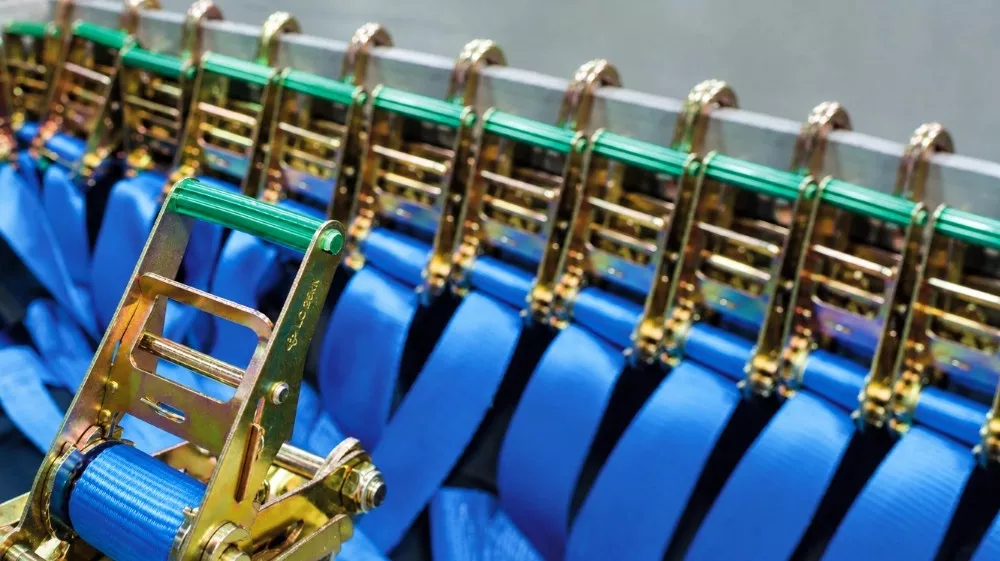
Ratchet straps are used in road transport to hold cargo in place and secure loads. Depending on the type of transport and the load to be secured, the choice of strap may vary in terms of width, length, hook, tensioning system, or lashing capacity.
Straps come in various sizes and with lashing capacities tailored to the needs of each application. For road transport, the 50-mm-wide versions are the most commonly used. They are available in lengths ranging from 9 to 12 meters, with a lashing capacity of 2,500 daN.
This Forankra guide presents the types of ratchet straps, their characteristics, and best practices for their use.
What is a ratchet strap?
A ratchet strap is a securing device used to hold a load firmly in place during transport to prevent it from shifting. It consists of a fabric strap and a ratchet mechanism that allows the strap to be tightened gradually by operating a handle. It is used, in particular, to secure cargo on a trailer, secure equipment, hold a motorcycle in place, or secure items during a move.
The standard ratchet operates by moving the handle back and forth, which applies tension to the strap and holds the load in place.
The Components of a Ratchet Strap
A ratchet strap consists of several components, each of which plays a specific role in securing the load:
- The webbing: Made of polyester, it provides the strength needed to secure the load during transport.
- The ratchet mechanism: turning the handle rotates the winding shaft onto which the strap is threaded. The system of gears (or ratchet pines) allows the mechanism to advance in small increments and maintain tension on the strap.
- The hooks: these are used to secure the strap to the designated anchor points on the vehicle or support structure.
A strap in good condition is not enough if the ratchet is defective, just as a functional ratchet cannot compensate for a damaged strap. The safety of the lashing depends on the condition of the entire system. Before each use, check that the strap has no cuts, tears, or significant fraying, and that the seams are intact. The hooks must also be free of deformation or cracks. The ratchet must function properly and maintain tension on the strap. Any strap, hook, or ratchet that is defective must be removed.
The Difference Between a Standard Ratchet and a Reverse Ratchet
With a standard ratchet, tension is applied by pushing the handle. The reverse ratchet, also known as an “Ergo,” works the other way around: the handle is pulled downward to tighten the strap.
This design requires less effort during use and makes the driver’s job easier, especially when handling heavy loads. The longer handle on the reverse ratchet also allows for a higher tension force (STF) than that of a standard model.
The reverse ratchet strap thus provides effective tension and more ergonomic handling, thereby reducing the risk of musculoskeletal disorders (MSDs).
Ratchet Strap Characteristics
To choose a ratchet strap, several elements must be checked: the lashing capacity, the standard tension force, and the strap length. The choice depends on the weight, dimensions, and type of load to be secured.
Standard Tension Force (STF)
The STF (Standard Tension Force) corresponds to the tension force exerted by the strap when tightened with a standard manual force (SHF) of 50 daN.
This pre-tension increases the pressure exerted on the load and therefore the friction between it and the transport surface. The STF value helps determine the number of straps needed to properly secure the goods.
Lashing Capacity (LC)
For direct lashing, the lashing capacity (LC) is the reference. Expressed in daN, it indicates the maximum tensile force the strap can withstand.
The daN (decanewton) is a unit of force. To simplify, 1 daN corresponds approximately to the weight of a 1 kg mass under normal conditions.
Thus, a strap with a load capacity (LC) of 500 daN can restrain a load of 500 kg.
Good to know: The standard manual force (SHF) defines the effort exerted on the tensioner to obtain the tension force indicated by the STF. The reference value set by the standard is 50 daN. Regarding the load capacity (LC), the EN 12195-2 standard requires that labels refer to direct tension. The user must take the lashing methods into account when calculating the number of straps required.
Types of Hooks Available for Ratchet Straps
When using a ratchet strap, several types of hooks are available:
- Heavy-duty straps with spread-finger hooks, also known as “quay-side” hooks
- Tight-finger hooks, also known as double hooks, are particularly suitable for rings and eyelets, providing a secure attachment.
- Safety latch hooks minimize the risk of accidental unhooking during transport.
- The magnetic hook is used to pre-position the strap while waiting to apply tension
Materials Used in the Manufacture of Ratchet Straps
The choice of material affects the strap’s strength and service life. Polyester (PES) is the most commonly used material for ratchet straps. It can be identified by a blue label.
What are the standards and regulations for ratchet tie-down straps?
In Europe, all tie-down straps must comply with the EN 12195-2 standard. This regulation sets strict requirements to ensure the strength, reliability, and safety of tie-down straps.
Good to know: With Forankra, you benefit from high-quality products certified to European standards and recognized expertise in the field of cargo securing.
Our tips for the safe use of ratchet tie-down straps
- Use compliant straps: Make sure the label is present and clearly legible. Do not use a strap without a label.
- Check their condition: Inspect the straps regularly for any cuts, wear, or damage.
- Store them properly: Keep them away from chemicals, UV rays, and sources of heat or fire.
- Choose a strap suitable for the load: The model must be appropriate for the weight, nature, and characteristics of the cargo.
- Check the securing during transit: regularly check the tension, especially after braking, vibrations, or significant movements.
- Use multiple straps if necessary: use at least two straps across the load when the load configuration allows it and depending on the securing method.
Customization of Ratchet Tie-Down Straps
Ratchet tie-down straps can be customized with a logo, company name, or any other branding. This branding makes it easy to identify the equipment, enhances the company’s visibility, and reduces the risk of the ratchet tie-down straps being lost or stolen.
A tool to make it easier to secure the strap
Using the MULTISTICK multifunction pole and the STRAP-GO tool, you can unroll 50-mm ratchet tie-down straps of various lengths with a simple flick of the wrist.
From the ground, the operator can position the STRAP-GO head at the load and simply perform a throwing motion to unroll the strap over the load. This method eliminates repetitive motions and reduces musculoskeletal disorders.
In Same Category
- 9 conseils pour bien choisir vos plaques de roulage
- Safety Stand : A Guide to Ensuring Safe Dock Operations
- Loading ramps for people with disabilities for vehicles, public buildings, and thresholds
- How to Choose a Truck Tie-Down Strap: The Complete Guide for Professionals
- Choosing the Right Loading Ramp: Tips and Expert Advice