


 Français
Which loading ramp should you choose for your commercial vehicle?
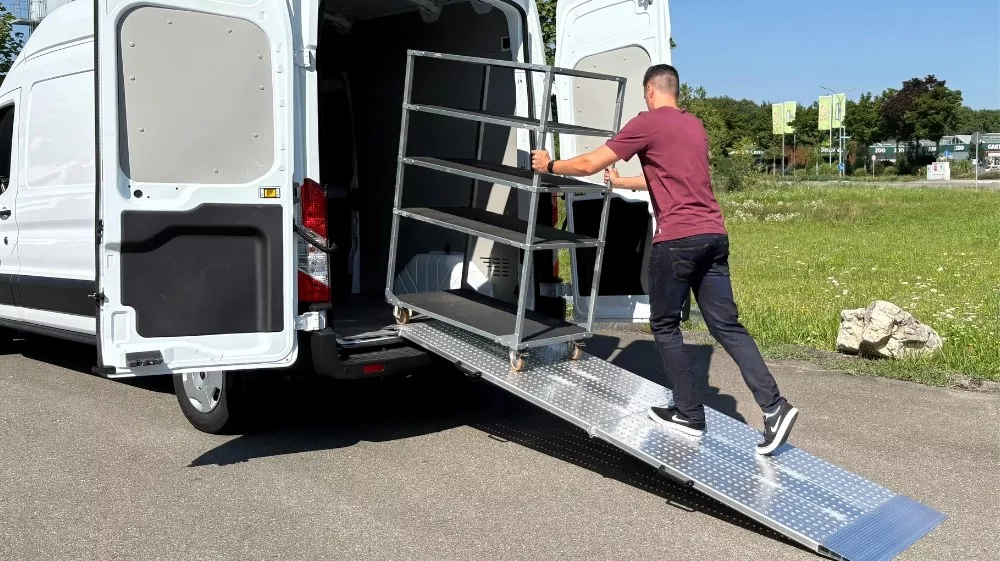
In Summary
- Three types of loading ramps are available to suit different uses: fixed-folding, fixed-swiveling, and removable.
- The choice of a ramp depends on its load capacity, length, slope, and the type of equipment to be loaded.
- A properly selected ramp improves operational safety, reduces handling effort, and facilitates loading.
- Insufficient capacity, an excessive slope, or an inappropriate width increase the risk of accidents and equipment damage.
Not all loading ramps meet the same needs. Depending on the equipment you’re handling, the configuration of your commercial vehicle, and how often you use it, some models will be more suitable than others. This Altec France guide presents the solutions available to meet the needs of your business.
The 3 Types of Loading Ramps for Commercial Vehicles
There are three main categories of loading ramps available for commercial vehicles. At Altec France, these three categories are covered by aluminum solutions designed for professionals in the transportation, logistics, and material handling industries:
Fixed Folding Ramp
The fixed folding ramp remains permanently attached to the utility vehicle. On the Altec France RRK model, the gas-spring-assisted folding system is a game-changer: no more straining to handle the ramp on a daily basis. The perforated, non-slip tread provides excellent traction for both pneumatic tires and tracks, even when the floor is wet or oily. The 40-mm side edges enhance safety and minimize the risk of vehicles rolling off the ramp.
In terms of load capacity, the standard version starts at 450 kg per ramp (maximum load ramp). The structural reinforcement option increases this capacity to 1,000 kg, allowing for the loading of heavy equipment such as floor scrubbers, electric pallet jacks, or material handling trucks. This type of folding ramp is designed for professionals who perform loading and unloading operations several times a day.
Fixed Swivel Ramp
The RRD fixed swivel ramp incorporates all the technical features of the foldable version, with an added benefit: it swivels 180° toward the inside or outside of the van. The result? Access to the interior of the vehicle remains open at all times, even when the ramp is extended. This swivel ramp facilitates material-handling operations.
This configuration is particularly useful for those who work with pallet jacks, hand trucks, or carts to load pallets and goods. The interior locking system (optional) secures the ramp in the inward position during transport.
Removable Ramps
Their lightweight aluminum design makes them easy to transport and store in a vehicle. No modifications to the van or truck are required. The ramps can be installed and removed in just a few seconds.
This design is ideal for mobile professionals who switch between multiple vehicles or move from one site to another. Landscapers, equipment delivery drivers, and event service providers appreciate how easy they are to use. These utility ramps can easily handle the loading of ride-on mowers, ATVs, motorcycles, or small construction equipment.
4 Technical Criteria for Choosing a Loading Ramp for Light-Duty Vehicles
The choice of a loading ramp for a light-duty vehicle is based on four criteria.
Load Capacity
To calculate the required load capacity, add the weight of the equipment, the operator, and any on-board accessories, and then add a 20% safety margin. This margin accounts for load variations and dynamic stresses when the machine drives up the ramp.
Here are a few examples by type of equipment:
- Manual pallet jack (60 kg) + operator (80 kg) + loaded pallet (190 kg) + 20% safety margin = 396 kg → a 450-kg ramp is suitable.
- Ride-on mower (250 kg) + operator (80 kg) + accessories (20 kg) + 20% margin = 420 kg → a 450 kg ramp is sufficient
- Scrubber-dryer (400 kg) + operator (80 kg) + water (50 kg) + 20% margin = 636 kg → in this case, a reinforced 1,000-kg ramp is required
- Compact forklift (600 kg) + load (200 kg) + 20% margin = 960 kg → a reinforced 1,000 kg ramp is required
Slope and Ramp Length
To calculate the slope, divide the height of the vehicle's loading threshold by the length of the ramp, then multiply by 100 to get a percentage.
Recommended maximum gradients by equipment type:
- Manual pallet jack: 5 to 8%
- Forklift: 8 to 10%
- Ride-on mower: 15 to 20%
- ATV or motorcycle: 25 to 30%
- Hand truck with pneumatic tires: 10 to 12%
- Mobile lifting equipment: 8 to 12%
A ramp that is too short creates an excessive slope. The consequences? Risk of tipping, loss of control, or the equipment getting stuck. The length must be calculated before purchase by measuring the actual height of the vehicle’s floor from the ground.
Frequency of Use
Professionals who perform more than 10 loading operations per day will see increased productivity with a fixed ramp.
Conversely, those who use the ramp only occasionally or who regularly switch vehicles are better off choosing removable ramps. This solution offers maximum flexibility without the need to invest in a fixed installation. The choice between fixed and removable ramps should take into account the number of loading operations and the number of vehicles used.
Type of Tread and Dimensions
The type of tread on the equipment directly affects the width and configuration of the ramp. Pneumatic tires require sufficient width to ensure lateral stability, whereas rubber tracks require a flat, continuous surface.
Recommended dimensions and specifications based on equipment:
| type of equipment | type of ramp | minimum usable width | recommended length | maximum slope |
| Manual/Electric Pallet Jack | Wide Fixed Handrail | > 800 mm | 2 a 2,5 m | > 8 % |
| Compact forklift | Reinforced Fixed Handrail | > 1000 mm | 2,5 a 3 m | > 10 % |
| Ride-on mower | Removable ramps (pair) | > 300 mm / per ramp | 2 a 2,5 m | > 20 % |
| Floor Scrubber | Reinforced Fixed Handrail | > 800 mm | 2,5 a 3 m | > 12 % |
| ATV or motorcycle | Removable ramps (pair) | > 250 mm / per ramp | 2 a 2,5 m | > 30 % |
| Hand truck with wheels | Fixed or removable railing | > 400 mm | 1,5 a 2 m | > 12 % |
The perforated, non-slip tread surface of Altec France’s aluminum ramps ensures traction for various types of wheels and tracks, even on wet or oily surfaces. The thickness of the aluminum (between 3 and 5 mm, depending on the model) ensures the structure’s strength while maintaining a certain degree of lightness.
What are the benefits of loading ramps for commercial vehicles?
Loading ramps for commercial vehicles offer benefits that go far beyond simply making loading easier. These benefits extend to operator safety, operational productivity, and the overall profitability of the business.
Enhanced Safety for Operators
Loading ramps for light-duty vehicles eliminate the dangerous tasks associated with manually lifting heavy equipment. The non-slip surface reduces the risk of slipping, even in wet conditions. The side rails prevent vehicles from rolling off the ramp, which can cause serious accidents. For professionals who load pallet jacks, hand trucks, or carts on a daily basis, these safety measures help reduce work stoppages and musculoskeletal disorders (MSDs).
Time Savings and Productivity
A fixed, foldable ramp allows you to start a loading operation in less than 10 seconds. There’s no longer any need to remove removable ramps, position them, check their stability, and then put them away after use. For a professional who handles 15 to 20 loading operations per day, the time saved easily amounts to 1.5 to 2 hours per day. This freed-up time directly translates to increased delivery capacity or a reduction in overtime.
Protection of Equipment and Cargo
Loading ramps ensure a smooth transition between the ground and the vehicle floor. Repeated impacts caused by abruptly crossing the loading threshold can damage equipment, wheels, and chassis. A properly sized ramp protects equipment and extends its service life. Transported goods experience less jostling, which reduces breakage and customer complaints.
Versatility
A loading ramp isn’t just for pallet jacks or forklifts. It also makes it easier to load lawn mowers, floor scrubbers, small construction equipment, ATVs, motorcycles, and any other wheeled equipment. This versatility is particularly appealing to professionals who work in multiple fields and transport different types of equipment depending on the job site.
How to Safely Use a Loading Ramp for Light-Duty Vehicles?
The use of a loading ramp for light-duty vehicles is subject to specific safety rules. Following these guidelines ensures the safety of operators and protects loading and unloading equipment.
Preparation Before Use
Before each loading or unloading operation, several checks must be performed. The vehicle must be parked on a level and stable surface. The ramp must be fully extended and locked in the operating position. The hinges and mounting points should undergo a quick visual inspection to detect any abnormalities.
The ramp’s running surface must be clean and free of grease, mud, or debris that could reduce traction. In rainy or freezing weather, quickly cleaning the non-slip surface improves safety.
Loading Techniques by Equipment Type
Each type of equipment requires a specific technique. For a manual pallet jack, the operator drives in reverse while pulling the pallet jack, which provides better control over the descent. For an electric pallet jack or forklift, the operator drives forward at a reduced speed and comes to a gradual stop once inside the vehicle.
Ride-on mowers and ATVs should be driven up in first gear at a constant engine speed. The operator should keep the center of gravity shifted forward to prevent the vehicle from tipping backward. For tracked equipment, the speed must remain very slow to maintain traction along the entire length of the ramp.
Hand trucks and manual carts should always be maneuvered in reverse when going up a ramp, keeping the center of gravity low.
Safety Instructions
Several safety rules apply. The ramp’s maximum load capacity must never be exceeded.
Removable ramps must be positioned with a precise spacing that matches the wheelbase of the vehicle. Incorrect spacing destabilizes the equipment and can cause accidents. For fixed swivel ramps, ensure they are locked in the operating position before each use.
2 Common Mistakes When Choosing a Light-Duty Truck Loading Ramp
Underestimating the Required Capacity
The number one mistake: calculating the load capacity based solely on the weight of the equipment, while overlooking the weight of the operator and accessories. A 180-kg pallet jack carrying a 50-kg pallet with an 80-kg operator generates an actual load of 310 kg.
The lack of a 20% safety margin exacerbates the problem. Dynamic stresses when moving across the ramp—acceleration, braking, and vibrations—temporarily increase the applied load. An undersized ramp gradually deforms and eventually poses a real risk of failure.
Choosing an Inappropriate Width
The width of the ramp must match the width of the equipment’s wheels or tracks, with a lateral safety margin. A ramp that is too narrow increases the risk of the equipment veering off the ramp, especially during course-correction maneuvers.
For removable ramps used in pairs, the spacing between the two rails must correspond exactly to the wheelbase of the machine. Incorrect spacing destabilizes the equipment and generates lateral stresses on the wheels.
Why Choose Aluminum Loading Ramps for Your Commercial Vehicle?
Aluminum is the most commonly used material for professional loading ramps. Lighter than steel while offering equivalent load capacity, it makes day-to-day handling easier—especially for removable ramps—and minimizes the added weight to the vehicle when installed as a fixed unit.
Another advantage: aluminum is corrosion-resistant. The ramps require no paint or special treatment to maintain their performance over the years.
Their perforated surface also provides good traction during loading, even under less-than-ideal conditions.
Aluminum ramps are suitable for year-round outdoor use, regardless of temperature. Depending on the Altec France model, the profile thickness is designed to withstand the expected loads while ensuring the equipment remains easy to handle.